Hyundai Accelerates Vehicle Development with Virtual Road Load Data Acquisition

Challenge
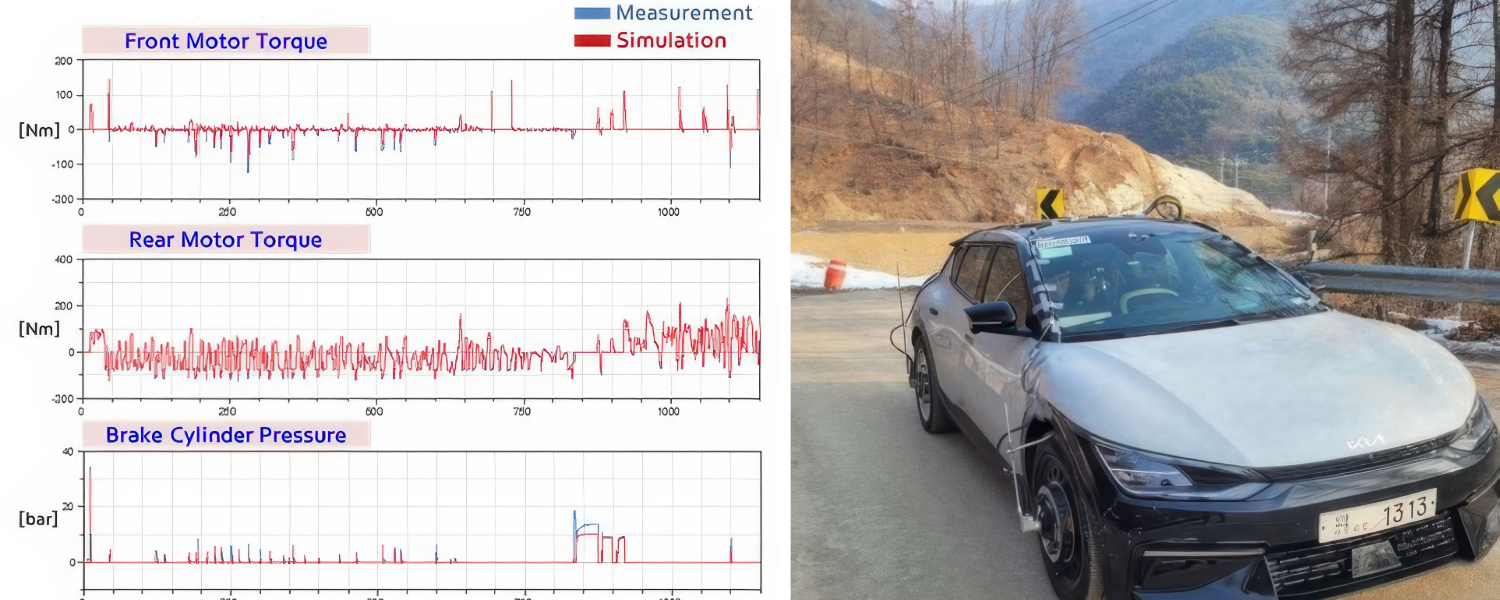
Improve development efficiency by reducing prototype production and testing costs through simulation but required validation against real-world data before wider deployment.
Solution
Implemented VeSyMA-based Virtual RLDA platform with year-long knowledge transfer, creating validated models configurable via HMC-standard inputs.
Results
Platform delivers durability data within tolerance of physical tests, expanding from single user to multiple teams, reducing physical testing and accelerating development cycles
Building on simulation excellence
Following the successful implementation of the Virtual Road Load Data Acquisition (RLDA) platform, HMC continues to transform its vehicle development process. What began as a one-year validation project has evolved into an integral part of the engineering workflow, changing how durability testing and development cycles are approached.
“Through our collaboration with the Claytex team, HMC developed version 1 of its Virtual RLDA platform, and currently, used internally for virtual durability testing. Claytex delivered a seamless, reliable, real-vehicle-like model. VeSyMA is an excellent tool for automotive engineers and, personally, it has made durability analysis much easier. We look forward to continuing our work together on durability solutions for HMC’s next-generation technologies.”
Jae Wung Jung, Senior Research Engineer
Durability Technology Team | Hyundai Motor Company
The evolution
After proving the accuracy and reliability of the VeSyMA-based Virtual RLDA platform through rigorous validation against the IONIQ 5, HMC has expanded the platform’s deployment across multiple vehicle programs. The initial investment in embedding an engineer at Claytex offices for a year has paid dividends, as that knowledge transfer now cascades throughout their engineering organization.
The platform, which simulates suspension systems, motors, thermal behaviour, and controllers, has moved from a single-user proof-of-concept to an expanding tool used by multiple teams. The spreadsheet-based configuration system allows engineers company-wide to quickly generate vehicle models without deep simulation expertise, democratizing access to advanced virtual testing capabilities.
Measurable impact
The Virtual RLDA platform is delivering on its promise to reduce physical testing requirements while accelerating data availability. Engineers now access critical durability data weeks earlier in the development cycle, enabling design decisions that would have previously required waiting for physical prototype testing.
While the original project focused on validation, confirming the platform produced data within tolerance compared to physical tests, teams are now using the validated models to explore design variations, optimize component sizing, and predict durability issues before committing to expensive physical builds.
Strategic advantage
For HMC, simulation is no longer just a validation tool, it’s become a development accelerator. The Virtual RLDA platform exemplifies the commitment to engineering efficiency, leading to compress development timelines and reduce costs while maintaining the rigorous quality standards.
Working together
The collaboration with Claytex team continues as HMC teams refine their models and extend the platform to cover additional vehicle systems and testing scenarios, ensuring they remain at the forefront of virtual development methodologies in the automotive industry.
Future work
Building on the success of the validation, the next steps are expanding deployment to cover their entire vehicle portfolio, branching out to cover all road going vehicles that HMC produce.
Essential software for ensuring digital continuity and sustainable innovation


Want to receive more content like this?
Our monthly thought leadership newsletter delivers detailed digital engineering knowledge directly to your inbox. Our experts provide their insights on the latest trends and innovations across disciplines such as:
- Advanced simulation
- Digital engineering
- Product lifecycle management
- Virtual twin


