Rethinking Engineering Simulation

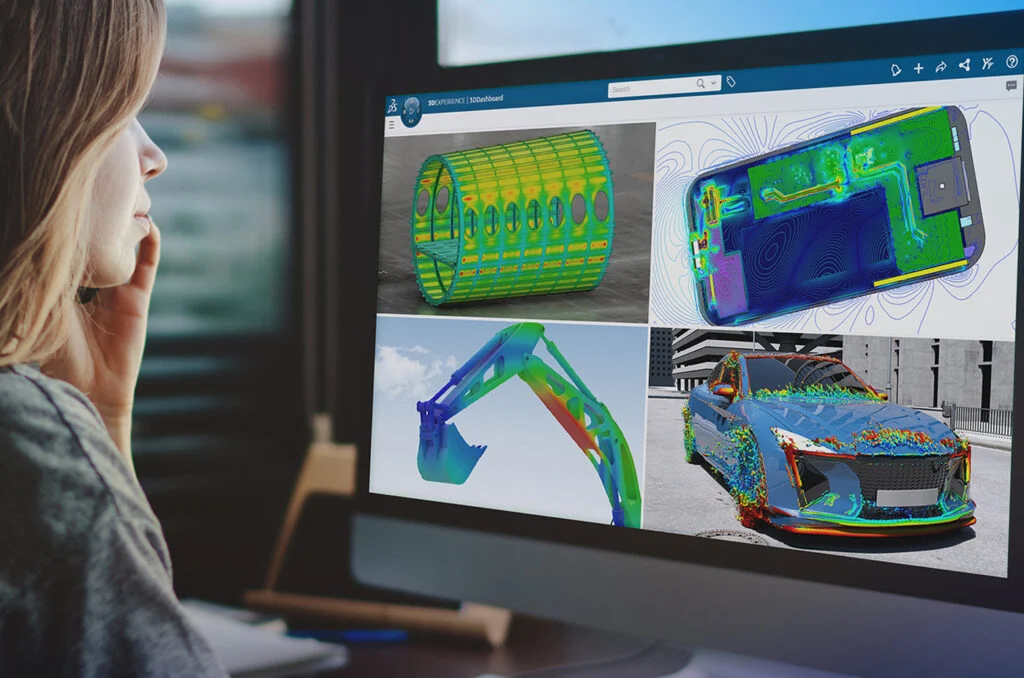
Table of contents
Simulation has fundamentally changed in recent years. What used to be a highly specialised discipline, carried out exclusively by experts in separate departments, is now evolving into an integral part of product development—accessible to far more users and closely integrated with design, data management, and manufacturing.
For companies, this means a clear shift: simulation is no longer a downstream verification step, but a decision-critical tool throughout the entire development process.
Simulation as a driver of innovation and speed
The role of simulation has changed fundamentally. While it previously served primarily to verify finished designs, it is now used specifically to validate decisions early.
Designers can evaluate variants at an early stage, identify weak points, and recognise optimisation potential—long before physical prototypes are built. This shortens development times, reduces costs, and at the same time improves product quality.
At the same time, simulation forms the basis for many key industrial developments: virtual twins, data-driven development, additive manufacturing, and automated optimisation processes are unthinkable without it.
There are no digital twins without simulation.
The shift: simulation becomes widely available
For many years, simulation came with a clear barrier: it was considered complex, time-consuming, and reserved exclusively for experts. As a result, many companies outsourced it or used it only selectively.
This very barrier is now being broken down. The goal is to bring simulation to a broader audience and make it usable for far more users.
In practical terms, this means that designers and development engineers are increasingly using simulation themselves to make well-founded decisions. Experts remain indispensable—however, their role is shifting. Instead of only verifying, they are more involved in shaping and optimising products.
The 3DEXPERIENCE platform as an enabler
Integrated platforms such as Dassault Systèmes’ 3DEXPERIENCE platform play a central role in this development.
It enables an end-to-end connection between design, simulation, and data management across the entire value chain. Design changes are transferred directly into simulation, and results flow straight back into the development process. This creates a synchronous, consistent data flow.
What is particularly crucial is how simulation is delivered: high-performance technologies run in the background, while users access exactly the functions they need for their tasks via intuitive interfaces.
At their core, these applications rely on proven high-end technologies, such as:
- Abaqus for structural analyses
- Tosca for structural optimization
- CST Studio Suite for electromagnetic simulation
This combination of performance in the background and ease of use on the surface is the key to the democratisation of simulation.
Simulation and AI: new dimensions in product development
In parallel, combining simulation with artificial intelligence opens up entirely new possibilities. While simulation delivers physics-based results, AI provides speed, automation, and intelligent evaluation.
In practice, this means, for example, that variants can be generated and evaluated automatically, or optimisation potential can be identified more quickly. Decisions are no longer based on individual simulations, but on a large number of analysed scenarios.
This combination is sustainably changing the way engineering works—from reactive analysis to proactive, data-driven development.
End-to-end processes instead of silo solutions
With stronger integration of simulation, the importance of end-to-end processes also increases. Modern product development requires continuous exchange between design, simulation, and other disciplines.
Every change in the CAD model must be reflected immediately in the simulation—and vice versa. Equally important is the unambiguous assignment of results to specific development states, materials, and boundary conditions.
Only in this way can a consistent digital thread be created, running from the first idea through to production and providing a reliable basis for decision-making.
The role of an experienced simulation partner
As powerful as the technologies are, their successful use depends largely on how they are implemented and used within the company.
Introducing modern simulation solutions is not only a technical task, but above all a strategic one. It is about identifying the right use cases, adapting processes sensibly, and developing the organisation step by step.
An experienced simulation partner helps to find precisely this balance: between rapid usability, methodological depth, and sustainable scaling. The goal is to embed simulation in the company so that it delivers real added value—not only selectively, but long term.
Conclusion: simulation belongs at the centre of product development
The trend is clear: simulation is evolving from a specialised discipline into a core component of modern product development.
Companies that actively shape this change benefit in multiple ways. They make better-informed decisions, reduce risks, and accelerate their innovation cycles.
The technologies are available, the platforms are established, and the barriers to entry are continuously decreasing.
Today, simulation is no longer a specialist topic; it’s a strategic success factor.
Simulation of the past vs. simulation today
| Simulation: past | Simulation: today | |
|---|---|---|
| Role in the development process |
|
|
| Users & accessibility |
|
|
| Speed & efficiency |
|
|
| Integration & processes |
|
|
| Goal & added value |
|
|
Simulation is no longer a specialist topic—it is a core component of modern product development.
Take the next step now
Speak with experienced experts with no obligation, gain clarity about your simulation options, and identify specific use cases for your company.
Get started now—an initial conversation will move you forward faster than you think.
Want to receive more content like this?
Our monthly thought leadership newsletter delivers detailed digital engineering knowledge directly to your inbox. Our experts provide their insights on the latest trends and innovations across disciplines such as:
- Advanced simulation
- Digital engineering
- Product lifecycle management
- Virtual twin


