A Unified Platform for Bridge and Lock Analysis and Design

Challenge
WSP needs tools that support advanced engineering – but also scale with business needs. Speed, adaptability, and global collaboration are essential to deliver high-quality infrastructure under tight deadlines.
Solution
BRIGADE provides the power of custom modelling and the simplicity of standardized workflows. With both BRIGADE/Standard and BRIGADE/Plus, WSP can quickly develop parametric bridge designs – or take on more complex structures, like canal locks.
Results
With BRIGADE, WSP can streamline its modelling workflows, enabling faster design and delivery without compromising technical depth. The license structure allows teams in Sweden and Poland to collaborate effectively, maximizing available resources across borders. With reliable support from TECHNIA, challenges can be solved quickly, ensuring that projects keep moving forward, even when complexity increases.
A platform built for purpose
WSP’s approach to infrastructure isn’t just about building bridges, it’s about designing solutions that support society over time. Projects must meet the highest standards of safety, longevity, and environmental performance. This places high demands on every tool used in the process.
With BRIGADE, WSP has a platform that keeps up with these expectations. The software combines industry-specific depth with powerful workflows and features, making it possible to move efficiently from idea to analysis to verified design. It not only supports code-based checking and load combination generation, but also the kind of transparency and traceability that modern infrastructure owners expect.
For WSP, this isn’t just about checking boxes, it’s about aligning with long-term strategic goals: sustainable development, digital transformation, and client trust.
Standardizing speed with BRIGADE/Standard
For the most common types of bridges, WSP use BRIGADE/Standard. One of the most appreciated aspects of it, is how quickly engineers can get started, without sacrificing analytical strength. The parameterized modelling approach lets WSP teams rapidly generate and adapt bridge models across a wide range of typologies: frame bridges, integral bridges, prestressed structures, and more. This structured yet flexible setup allows WSP to scale its workflows effectively across different project types and regions. The ability to re-use logic and geometry speeds up the design process significantly, helping project teams meet tight timelines while maintaining technical clarity. In a business where time is money, this kind of tool makes a difference. It’s structure also allow for convenient quality assurance and documentation, both crucial in large public-sector infrastructure projects, where every decision must be justified and every assumption tracked.
Going beyond with BRIGADE/Plus
While BRIGADE/Standard covers a large share of everyday bridge design, some projects require more advanced modelling and analysis capabilities. That’s where BRIGADE/Plus comes in. WSP uses Plus to handle complex, non-standard structures, not only bridges, but also other infrastructure components like sluices and canal locks. One example is the structural modelling carried out for the Södertälje canal lock and its adjacent bascule bridge, where BRIGADE/Plus enabled engineers to capture both the overall and local structural behavior with required precision. The goal for the project itself is to improve navigability in the Södertälje lock and canal for both longer and wider vessels and thereby creating a more sustainable goods transportation in the lake Mälaren [WSP].
At WSP, Arman Mulek got the considerable task of setting up both the model and handle the result evaluation of the bascule bridge. During his studies in structural and civil engineering at KTH, the Royal Institute of Technology Sweden, he used Abaqus, which made him well-prepared to work with BRIGADE/Plus as it is built on top of its platform.
See also, “From Abaqus to Bridge Analysis – without starting from scratch.”

Detailed modelling of the Södertälje Bascule Bridge
For the bridge project, two separate models were developed. First, a simplified model, with an orthotropic steel deck was modelled, combined with beam elements for the main and cross girders was used for the global design of the primary load-bearing structure.

Image: Peab/ Jägnefält Milton AB.

In parallel, a more detailed shell model was created for local stress verification, comparison between modelling approaches, and to evaluate fatigue performance during the opening phase of the bridge.
Using the shell-based model, he could identify which vehicle configuration and lateral placement within the traffic lane produced the highest principal stresses around the cut-outs used for partial damage calculations. In talks with Arman it stood clear that for this approach, the traffic handling and load combination built-in modules in BRIGADE/Plus were the most valuable modules. Arman was aware how much time this feature saves him, and that going forward with this approach without it was not a feasible option.

The same model was also used to evaluate deformations and stresses in the counterweight box during the construction phase, before the concrete counterweight had hardened.

This level of modelling depth illustrates how BRIGADE/Plus supports multi-stage analysis, all within one platform. From conceptual simplifications to detailed verification.
Advanced simulation of sluice gates
Within the same project, Arman Mulek was also assigned to model and analyze the Södertälje sluice, and again the BRIGADE/Plus was chosen as his analysis tool. This time, the task was to analyze a pair of sector gates with vertical hinges meeting at the channel centerline. A single shell model was set up to verify all relevant limit states. Again, BRIGADE/Plus was used throughout the whole project, from building the model to analyze the results.

For this project, focus was not on handling traffic loads, instead the effects of the hydrodynamic pressure distribution on the structure were of key interest. For this purpose, the functionality of mapped fields in BRIGADE/Plus was used. Thanks to it, the results from Computational Fluid Dynamic (CFD) calculations could be imported to BRIGADE/Plus to carry out the structural design. By importing data from extensive .csv files – containing hundreds of thousands of coordinate and pressure values from propeller wash simulations – Arman could efficiently visualize and apply realistic loading conditions through customized scripts written for BRIGADE/Plus.
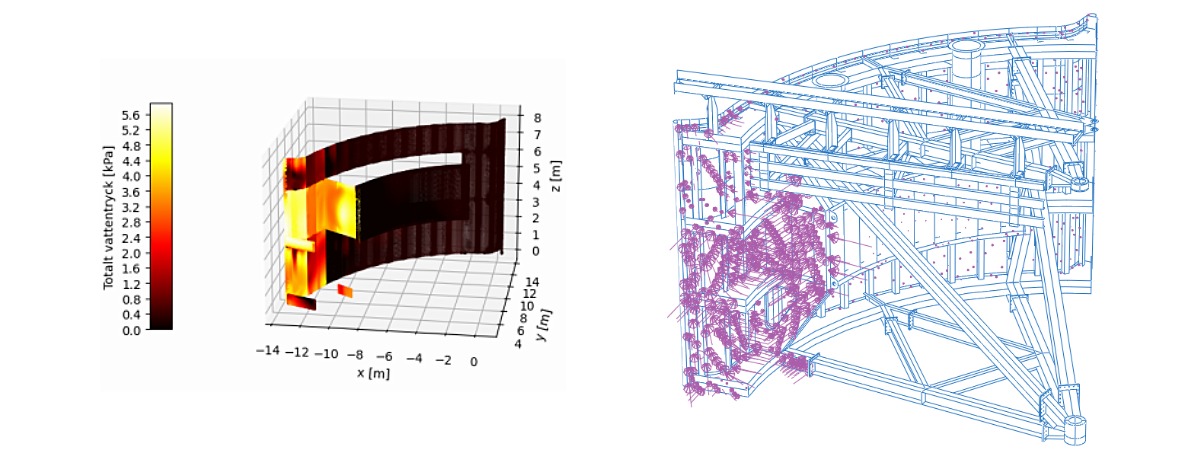
To assess structural stability, nonlinear buckling analyses were carried out directly in the finite element model. Eigenmodes were scaled according to EN 1993-1-5 and applied as geometric imperfections to evaluate both buckling of the lower gate arms and lateral torsional buckling of the upper frame members. (read more about how to perform buckling analyses in the BRIGADE/Plus buckling tutorial).

Through these advanced simulations, WSP could ensure that the design fulfilled both strength and serviceability requirements while capturing the true physical behavior of the gate system.
One tool for several purposes
Projects like these show the range of applications where BRIGADE/Plus provides value beyond traditional bridge design software.
By combining high-end analysis features, – such as mapped loading, nonlinear instability checks, and fatigue verification – with the usability expected from a civil-engineering tool, WSP’s teams can handle even the most demanding structural problems within a single environment.
The alternative, to use different structural analysis software for a project like this, would have put more demands on both the engineer – in this case Arman – and the WSP. With one software, Arman could reuse his knowledge of the software for the different tasks and WSP only need to manage one software, instead of several ones.
Global teams, unified tools
WSP operates in a globalized engineering environment. With project teams located across Europe and beyond, having software that supports collaboration across borders is a must. BRIGADE fits naturally into this setup.
Through a shared licensing model, for example engineers in Sweden and Poland can work together efficiently, using the same toolset, licenses and project standards. This creates organizational flexibility. Resources can be shared, delivery capacity can be scaled, and specialized knowledge can be brought in where needed.
From a strategic standpoint, this also supports WSP’s core strength: combining local insight with global expertise to deliver infrastructure that works – technically, economically, and environmentally.
A trusted partnership
Behind every successful software deployment stands a reliable partner. For WSP, TECHNIA has filled that role for over 25 years. WSP was one of the pioneers in Sweden in using BRIGADE, already in the 90s.
The collaboration goes far beyond just supplying software. TECHNIA’s simulation experts has provided deep knowledge of the software and its application in real-world engineering scenarios. Whether it’s answering a technical support request or helping solve a complex modelling issue. For any business – including WSP – that kind of reliability matters. It means fewer interruptions, faster resolutions, and more time spent on what really counts: delivering high-quality, future-ready infrastructure.
Essential software for ensuring digital continuity and sustainable innovation

For the structural analysis and design of bridges and civil structures.
Advanced simulation software
Enhance product design and testing with simulation software, offering accurate and efficient virtual prototyping capabilities.

View our extensive range of software solutions

Want to receive more content like this?
Our monthly thought leadership newsletter delivers detailed digital engineering knowledge directly to your inbox. Our experts provide their insights on the latest trends and innovations across disciplines such as:
- Advanced simulation
- Digital engineering
- Product lifecycle management
- Virtual twin


