Advancing Robotics with Multiphysics Simulation
Challange
Understanding and predicting the physical behaviour of a highly articulated robot, including joint loading, payload capability and actuator requirements, without relying solely on costly physical prototypes.
Solution
A Multiphysics Dymola model of the nine-axis Re-Vector arm, enabling Ross Innovation to simulate configurations, trajectories and joint loads virtually.
Result
Greater insight into robot performance, supporting motor sizing, payload assessment and faster evaluation of future designs before hardware is manufactured.
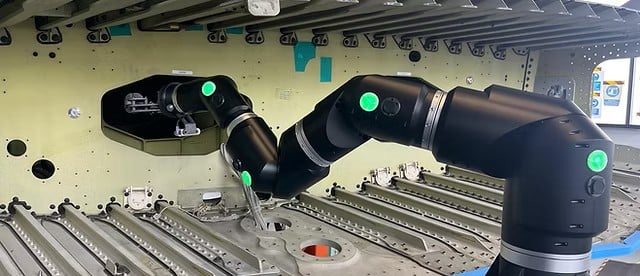
Ross Innovation is developing a new generation of highly articulated robotic manipulators designed to operate in confined, complex and hazardous environments. Unlike conventional robotic arms, the company’s Re-Vector® robot has a geometry-led articulated architecture that enables it to progressively deploy and reconfigure through and within constrained spaces, reaching around and between surrounding structures. This makes it particularly suited to demanding applications such as aerospace manufacturing and inspection, and intervention in nuclear environments.
Working with TECHNIA, Ross Innovation used Dymola to develop a Multiphysics model of its nine-axis Re-Vector arm. The collaboration demonstrated how physics-based simulation can move beyond verification to become an integral part of the design process, providing insight into mechanical behaviour, actuator loading and payload capability before committing to physical hardware.
THE CHALLENGE
Understanding performance beyond kinematics
Ross Innovation had already established the kinematics of Re-Vector and demonstrated its ability to plan movements and operate in constrained environments. The next challenge was to understand and predict the physical behaviour of the complete robotic system as it moved through different configurations.
Because Re-Vector has a highly articulated, nine-axis structure, its payload capability cannot meaningfully be represented by a single figure. Loads are distributed throughout the kinematic chain and vary according to the robot’s configuration, reach, direction of loading and movement.
The key challenges included:
- Understanding joint loading throughout the complete kinematic chain.
- Quantifying how different configurations affect payload capability.
- Predicting torque demand during representative robot movements.
- Exploring alternative designs before committing to physical hardware.
- Establishing a modelling approach that could support the development of future Re-Vector variants.
THE SOLUTION
A Multiphysics model in Dymola
TECHNIA worked with Ross Innovation to develop a Multiphysics model of the nine-axis Re-Vector arm in Dymola.
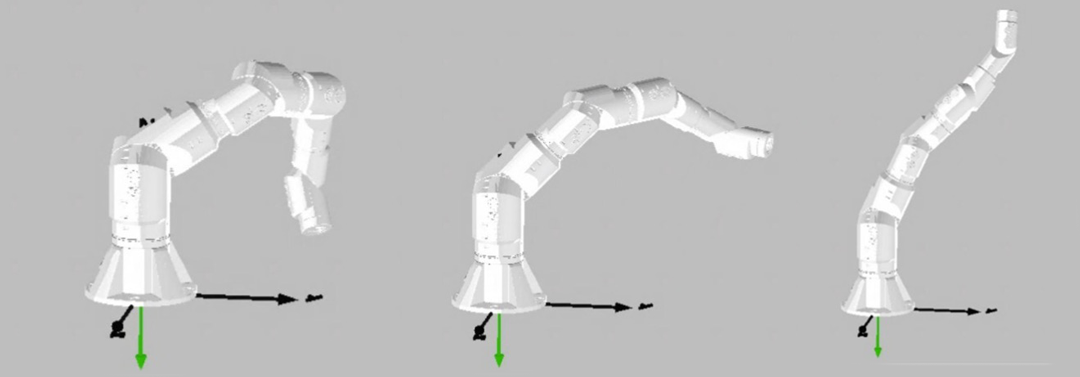
A standardised robotics description and an open-source robotics library were used to generate a Modelica-based model of the complete kinematic chain. The model incorporated the robot’s geometry and physical properties, including component masses, centres of gravity, inertia tensors and structural geometry, together with servo performance information.
This enabled representative configurations and trajectories to be simulated, and the resulting joint positions and torque demands to be examined throughout the robot’s movement. The model consequently provided insights into the physical behaviour of Re-Vector that could not be obtained from kinematic modelling alone.
The approach provides:
- Physics-based insight into the behaviour of the complete robotic system.
- Quantitative information to support motor and actuator selection.
- The ability to assess different configurations and trajectories virtually.
- A faster and more cost-effective way to evaluate concepts before building hardware.
A foundation for applying simulation to future Re-Vector designs.
THE RESULT
From simulation to predictive engineering
The modelling provided Ross Innovation with quantitative insight into how loads are distributed as Re-Vector moves through different configurations. Importantly, simulated trajectories showed smooth changes in torque demand without torque spikes. The analysis also identified instances of negative torque resulting from gravity-driven back-driving, particularly relevant given the robot’s regenerative power capability and its potential use in battery-powered applications.
The work demonstrated that Dymola can provide a quantitative basis for answering one of the most important questions facing a new robotic system: what can the robot carry, in which configuration, at what reach, and under what motion and actuator loads?
The benefits include:
- Greater understanding of the physical behaviour of the Re-Vector architecture.
- Quantitative insight into payload capability and actuator loading.
- The ability to assess alternative designs before manufacturing.
- Reduced reliance on physical prototyping for early design decisions.
- A foundation for developing application-specific robot variants.
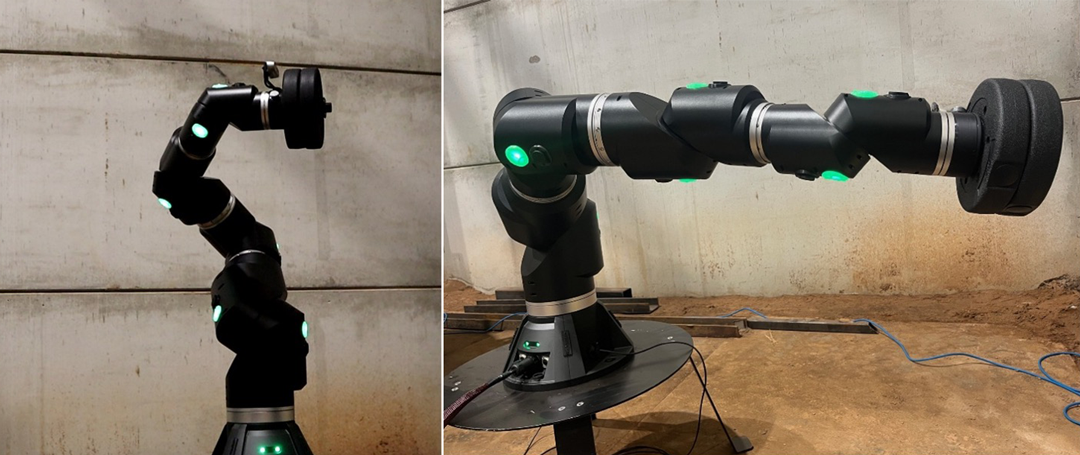
Following completion of the modelling, Ross Innovation began payload testing of the physical Re-Vector ZH1700 arm across a range of configurations. Comparing measured robot behaviour and actuator data with simulation results provides a means of progressively refining and validating the model, increasing confidence in its ability to predict the performance of future designs.
Working together and building on the results
The collaboration is opening the way for physics-based simulation to become an integral part of Re-Vector development rather than simply a verification activity. Ross Innovation aims to use the model to explore different arm lengths, actuator combinations, structural designs and application-specific configurations virtually, allowing performance to be assessed before hardware is manufactured.
A further development is to integrate the Multiphysics model more closely with the robot’s control system, using quantitative understanding of its physical behaviour to further refine task capability.
The collaboration also reflects TECHNIA’s ability to combine its engineering simulation expertise with innovative technology companies to turn novel engineering concepts into practical, data-driven development approaches. Ross Innovation’s work spans demanding aerospace and nuclear applications, where its highly articulated robots are being developed to perform inspection and engineering tasks in environments that are difficult or hazardous for people to access.

Want to receive more content like this?
Our monthly thought leadership newsletter delivers detailed digital engineering knowledge directly to your inbox. Our experts provide their insights on the latest trends and innovations across disciplines such as:
- Advanced simulation
- Digital engineering
- Product lifecycle management
- Virtual twin


